Choosing a China-based supplier for Powder Coating Stainless Steel requires more than comparing prices or viewing polished product photos. Stainless steel presents a demanding surface: oil, handling marks, and inadequate pretreatment can undermine coating adhesion. Ask suppliers how they clean and prepare each grade, control film thickness, and verify curing on finished parts. Details matter.
Grand View Research reported that the global powder coatings market was valued at approximately USD 15.8 billion in 2023, with continued growth projected through 2030. This market-wide figure indicates broad demand, but it does not measure stainless-steel coatings alone or certify any individual factory. Treat it as context, not proof. Quality-management expert W. Edwards Deming is widely credited with the line, “In God we trust; all others must bring data.” It is not a stainless-coating specialist’s quotation, but it captures a useful supplier-screening principle: request traceable test results, not assurances.
Look for documented adhesion, coating-thickness, and corrosion-resistance checks, alongside clear procedures for color matching and batch consistency. Request a sample made with the same stainless grade, geometry, and finish as your intended order. Then inspect edges, corners, and recessed areas under ordinary lighting. A sample can still mislead if production conditions differ. That risk deserves attention. Compare technical records, sample quality, communication, and production controls before ranking China’s best suppliers. No market report can replace a factory audit, and even a strong audit cannot guarantee every production run.
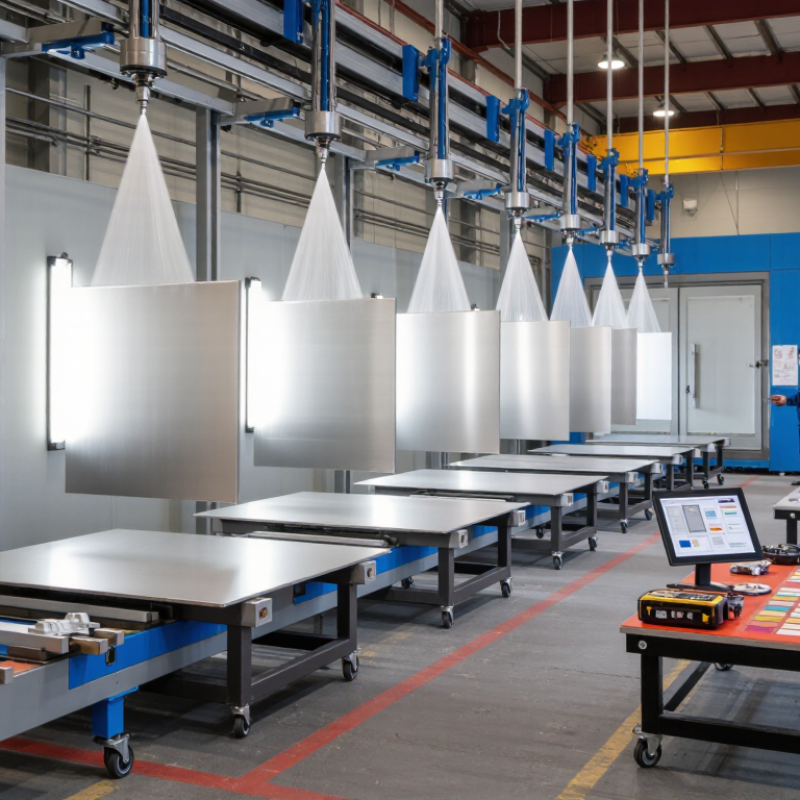
A China-based powder-coated stainless steel supplier is more than a factory address. It should identify the steel grade, provide traceable mill certificates, and explain how each surface is cleaned and prepared before coating. Preparation matters: oil, oxide, or uneven abrasion can weaken adhesion, even when a finished panel looks smooth. Ask for coating thickness records and documented curing temperatures, not just a polished sample. Small details count.
The World Stainless Association’s 2023 production report recorded 58.4 million tonnes of global stainless steel output. China represented a major share of that manufacturing base, but scale alone does not prove coating quality. A capable supplier should show batch records and relevant test results, such as adhesion checks under ASTM D3359 and corrosion testing under ISO 9227, with test conditions stated clearly. Salt-spray hours are not a direct promise of service life. That distinction is often missed. Buyers should also check whether the supplier tests production batches or only initial samples. A sample can pass while later batches vary. Factory audits, clear inspection limits, and honest answers about defects help reveal whether quality controls work in daily production.
Choosing a powder-coated stainless-steel supplier starts with the environment, not the finish colour. Grade 304 typically contains about 18% chromium and 8% nickel; grade 316 typically adds about 2% molybdenum. The Nickel Institute’s stainless-steel selection guidance describes molybdenum’s role in improving resistance to chloride-induced pitting. That matters near sea spray, de-icing salts, or chemical washdown.
A useful comparison is the pitting resistance equivalent number (PREN). The International Molybdenum Association gives the formula as %Cr + 3.3 × %Mo + 16 × %N. Using simplified nominal values, 304 scores around 19, while 316 with 2% molybdenum scores around 24. These figures help screen grades; they do not predict service life. For a dry indoor railing, 304 may be adequate. At a coastal site, 316 is often the more cautious choice. Still, it can corrode if salts remain trapped beneath damaged coating.
Ask suppliers how they clean and profile stainless steel before coating, and request a coated sample made from the proposed grade. Surface preparation is easy to overlook. Request adhesion results using ASTM D3359 and salt-spray test details using ASTM B117, but treat laboratory results as comparisons, not a guarantee of outdoor performance. Check whether the supplier reports coating thickness and inspects edges, welds, and drilled holes.
| Selection factor | Type 304 stainless steel | Type 316 stainless steel | What to check when sourcing powder-coated material |
|---|---|---|---|
| Typical composition (weight %) | Chromium: 18.0–20.0%; nickel: 8.0–10.5%; molybdenum is not a specified addition. | Chromium: 16.0–18.0%; nickel: 10.0–14.0%; molybdenum: 2.0–3.0%. | Confirm the grade and applicable product specification on the material test certificate; “18/8” is a common shorthand, not a complete composition specification. |
| Resistance to chloride exposure | Suitable for many indoor and general-purpose applications; more prone to pitting and crevice corrosion in chloride-bearing conditions. | Generally more resistant to pitting and crevice corrosion in chloride environments because of its molybdenum content; not immune to corrosion. | Consider salt spray, coastal exposure, cleaning chemicals, crevices, and coating damage. A coating does not eliminate the corrosion differences between the base grades. |
| Common application fit | Often used for indoor equipment, architectural components, food-service equipment, and general fabrication where exposure is moderate. | Often selected for marine-adjacent, coastal, chemical-processing, and other applications with greater chloride or chemical exposure. | Match the grade to the service environment, expected maintenance, design details, and applicable project specification—not to the coating color alone. |
| Powder-coating preparation | Requires a clean, properly prepared surface; stainless steel’s passive surface can make coating adhesion dependent on pretreatment and process control. | Also requires suitable cleaning and pretreatment; the same coating-process controls apply as for 304. | Ask for the specified cleaning and pretreatment process, coating system, film-thickness range, cure schedule, and adhesion-test method. |
| Fabrication and contamination | Fabrication practices should prevent embedded iron and other surface contamination that can contribute to rust staining. | The same contamination controls are important; the grade’s added corrosion resistance does not make contaminated surfaces risk-free. | Check that handling, abrasives, and finishing tools are suitable for stainless steel and kept free of carbon-steel contamination. |
| Verification documents | Request traceable documentation identifying the grade, product form, applicable standard, and heat or batch. | Request the same documentation and verify that the reported composition includes molybdenum within the specified range. | Review material test certificates and coating inspection records; agree on sampling, acceptance criteria, and independent testing if required. |
| Practical selection summary | A common choice when service conditions are moderate and the specification permits 304. | Consider when chloride exposure or corrosion risk makes the added molybdenum useful. | Compare grade, surface preparation, coating quality, traceability, and testing requirements as separate parts of the purchase specification. |
Composition ranges shown are typical ASTM A240 limits for common 304 and 316 sheet/plate specifications; verify the applicable standard and product form for each order. Corrosion performance depends on the environment, surface condition, design, and maintenance.
When comparing stainless steel powder coating suppliers in China, treat 60–120 μm as a working range, not a universal target. Film thickness affects appearance, edge coverage, and component fit. Around 60 μm may suit parts with tight clearances, but sharp corners can receive less coverage. Near 120 μm, a finish may look fuller, yet added build can affect threaded holes and moving parts. Small differences matter.
A useful specification states the acceptable thickness range, measurement locations, surface preparation, and curing requirements. Ask how thickness is checked and whether readings come from flat panels or actual parts. Stainless steel needs clean, properly prepared surfaces for reliable adhesion; the precise preparation method depends on the alloy and coating system. Cure conditions should follow the powder supplier’s guidance and account for the part’s actual metal temperature. I would not treat 100 μm as a magic number. It is a convenient midpoint, but not proof of performance.
Tips: Request a coated sample with corners, holes, and edges represented. Confirm gauge calibration and agree on how measurements will be recorded. A perfect-looking panel can still miss the needs of a real component.
For buyers comparing powder-coated stainless steel suppliers, ISO 2409 offers a practical way to check coating adhesion. A tester cuts a small grid through the coating to the metal, then inspects how much coating lifts from the squares. Class 0 means no visible detachment; Class 5 indicates extensive flaking, often across more than 65% of the cut area. Classes 1 to 4 mark increasing damage between those ends. Lower is better.
The result depends on careful preparation. Cut spacing must suit the coating thickness, and the blade should reach the substrate without gouging it. Where the chosen procedure calls for tape, its type and application should also be consistent. A Class 0 result is useful, not a guarantee: it cannot reveal every issue with corrosion resistance, curing, or long-term service. Ask suppliers for the test method, coating thickness, substrate preparation details, and results from representative parts—not just a polished sample panel.
Tips: Check the class under good lighting, and photograph the grid before and after testing. Compare like with like. If the coating is unusually thick or the cut edges look ragged, question the test setup; interpretation can be less clear than the neat class number suggests.
China Best Powder Coating Stainless Steel Suppliers?
Compare suppliers using evidence, not polished catalogues. Ask for a current ISO 9001 certificate, process-control records, and inspection results for coating thickness and adhesion. ISO 9001 provides a quality-management framework; it does not guarantee a flawless finish. Request photos of actual parts, including corners and welds, where thin coverage can hide. A small sample run is useful. It can still miss batch variation.
Capacity needs a reality check. Ask for monthly output by product type, curing-oven dimensions, and production schedules—not just a headline figure. The World Stainless Association reported 58.4 million tonnes of global stainless-steel production in 2023, showing the scale of the supply chain, but not any single supplier’s available capacity. For export experience, review recent shipment records, packaging photos, lead-time performance, and responses to transit damage. I would also ask for a reference from a comparable overseas order; paperwork alone feels incomplete.
Tips: Request a sample made with your steel grade, colour, and target film thickness. Compare the measured result with the supplier’s report. Ask how rejected parts are recorded and corrected. Small gaps in documentation matter. Check them before ordering.
Suggested evaluation weighting for comparing suppliers by quality systems, production capacity, and export record. These percentages are a buyer-side framework, not ratings or market statistics for specific companies.
Assess quality using current certificates and documented inspection processes; capacity using verified output, lead times, and production flexibility; and export record using relevant shipping documents and experience with your destination market. Adjust the weights to match your project requirements.
304, with about 18% chromium and 8% nickel, may suit dry indoor railings. Conditions still matter.
316 typically contains about 2% molybdenum, which improves resistance to chloride-related pitting. Salt trapped under damaged coating can still cause corrosion.
No. Simplified values are about 19 for 304 and 24 for 316. They help compare grades, but cannot predict real-world lifespan.
It is a working range, not a universal target. Thicker coating may affect threaded holes or moving parts. Small details matter.
State the thickness range, measurement locations, surface preparation, and curing requirements. Check readings on actual parts, not only flat panels.
Request a sample using the proposed steel grade and coating. Look closely at corners, welds, drilled holes, and edges. A neat panel can mislead.
Ask for current quality-system documentation, coating-thickness records, adhesion results, and rejected-part reports. A certificate alone proves little about each batch.
Ask about monthly output, oven dimensions, recent shipment records, packaging photos, and lead-time performance. Paperwork helps, but it feels incomplete without comparable order references.
Choosing a China-based Powder Coating Stainless Steel supplier involves more than comparing prices. Buyers should confirm that the supplier can provide traceable material specifications, consistent finishing, and export-ready documentation. Stainless steel grade affects performance: 304, with approximately 18% chromium and 8% nickel, suits many general applications, while 316 includes about 2% molybdenum for improved resistance in more demanding environments. The intended use should guide the grade selection.
Coating requirements also need clear verification. A typical powder-film thickness of 60–120 μm can serve as a starting point, but the specification should match the product’s environment and finish requirements. ISO 2409 adhesion testing grades coatings from Class 0, indicating strong adhesion, to Class 5, indicating extensive detachment. When comparing suppliers, assess their quality systems, production capacity, inspection practices, communication, and export record to determine whether they can deliver consistent products and dependable service.
SSEART