What Is Golden Powder Coating and How Does It Work?

Time:2026-10-18 Author:Charlotte
0%

Golden Powder Coating is more than a bright metallic finish. It is a dry, electrostatically applied coating containing resin, pigment, additives, and metallic-effect particles. Technicians charge the powder, spray it onto a grounded metal surface, then cure it in an oven. Heat melts the particles and cross-links the resin into a continuous film.

The process sounds simple. It is not always forgiving. Poor grounding can create uneven coverage, while excessive heat may dull golden pigments. Clean steel, controlled film thickness, and accurate oven temperature remain essential. A practical target often falls near 60–100 microns, although specifications vary by product and application.

Market evidence supports the coating’s growing relevance. Grand View Research valued the global powder coatings market at approximately USD 14.3 billion in 2023. Its report projects continued growth through 2030, supported by durable finishes and reduced solvent emissions. The Powder Coating Institute also identifies powder coating as a high-transfer-efficiency process, because unused powder can sometimes be recovered and reused.

Powder coating consultant Kevin C. Biller summarizes the discipline clearly: “Powder coating is a process, not a product.” That distinction matters. Golden Powder Coating can look like polished brass, warm champagne, or antique gold, but appearance depends on formulation and application control. A sample panel should be tested first. Color charts can mislead.

This guide examines how Golden Powder Coating works, where it performs well, and why curing, preparation, and quality inspection determine the final result. Some finishes will disappoint. That is useful information, not failure.
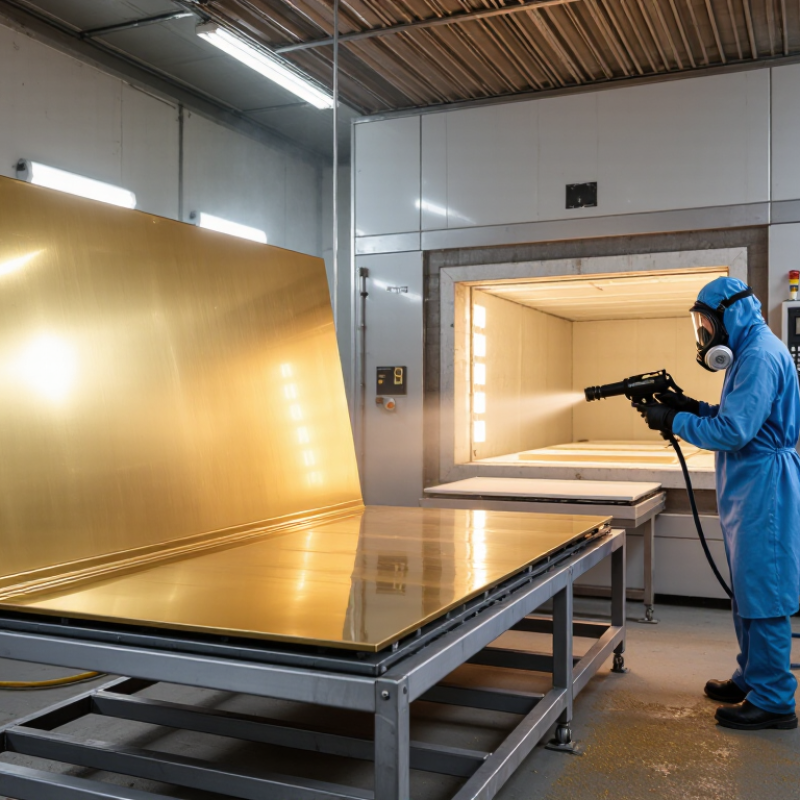
What Is Golden Powder Coating and How Does It Work?

Golden Powder Coating: Resin, Metallic Pigments, and Near-Zero VOCs

What Is Golden Powder Coating and How Does It Work?

Golden powder coating combines thermoset resin, metallic pigments, and heat. The resin forms the protective film. Metallic pigments create a warm, reflective gold appearance. During curing, the powder melts and crosslinks inside an oven, forming a hard surface on prepared metal. The finish can resist impact, moisture, and moderate chemical exposure. However, color consistency depends on film thickness, grounding, and oven temperature. Gold is less forgiving than flat colors.

Its near-zero VOC profile comes from its solid formulation. The U.S. Environmental Protection Agency’s Powder Coatings technical guidance states that these coatings contain no solvents and release little or no VOCs during application. Industry guidance from the Powder Coating Institute reports transfer efficiency can reach about 95%, especially when overspray is recovered. That reduces material waste, though pretreatment cleaners and curing energy still affect total emissions. Near-zero is not zero. That distinction matters.

Tips: Ask for a technical data sheet and verify resin chemistry, pigment type, recommended thickness, and curing conditions. Metallic pigments may create shade variation between batches. Test a small panel first. The European Commission’s surface-treatment guidance also emphasizes preparation, thickness control, and process monitoring. In practical work, a clean substrate often matters more than an expensive powder. I have seen attractive gold finishes fail because oil remained near welds. Good appearance cannot hide weak preparation.

Electrostatic Application at 30–100 kV and Up to 95% Transfer Efficiency

Golden Powder Coating: Electrostatic Application at 30–100 kV

Golden powder coating uses electrically charged powder particles instead of liquid paint. A spray gun commonly applies 30–100 kV, according to technical guidance published by the Powder Coating Institute. The voltage gives particles a negative charge. The grounded metal part then attracts them, creating a visible, even layer around edges and recessed surfaces.

This process can reach transfer efficiency levels of up to 95%. The U.S. Environmental Protection Agency’s AP-42 surface-coating data identifies powder coating transfer efficiency as roughly 60–95%, depending on equipment and operating conditions. Less overspray reaches the booth floor. More powder reaches the workpiece. That improves material use, although recovery systems still require careful cleaning and control.

Voltage alone does not guarantee quality. Poor grounding, excessive airflow, or uneven film thickness can reduce deposition. In practical workshops, operators check the part’s contact point before adjusting voltage. Small defects often begin there. A golden finish also reveals contamination quickly, especially on smooth panels. The 95% figure is an upper-end result, not a promise. Real performance should be measured from powder consumed, recovered, and deposited during each production run.

What Is Golden Powder Coating and How Does It Work?

Electrostatic powder coating uses charged powder particles and a grounded workpiece to attract the coating before oven curing. Typical electrostatic application voltage is approximately 30–100 kV, while transfer efficiency can reach up to 95% under suitable operating conditions.

The voltage is shown as a range from 30 to 100 kV. The 95% figure represents an upper-end transfer-efficiency value and is not a guaranteed result; actual efficiency depends on equipment settings, powder characteristics, part geometry, grounding, and recovery practices.

Curing Golden Films at 160–200°C Metal Temperature for 10–20 Minutes

What Is Golden Powder Coating and How Does It Work?

Curing Golden Films at 160–200°C Metal Temperature for 10–20 Minutes

Golden powder coating creates a decorative, durable finish without liquid solvents. Technicians spray charged powder onto a grounded metal surface. The particles cling evenly, even around edges and shallow recesses. During heating, the powder melts, flows, and forms a continuous golden film. The color comes from carefully selected pigments and metallic effects. Small changes in pigment concentration can noticeably alter the final shade.
Curing must be judged by the metal temperature, not only the oven display. The workpiece should reach 160–200°C and remain within that range for about 10–20 minutes. That distinction matters. Thick steel heats slowly, while thin aluminum may reach temperature quickly. Measure the metal. Contact thermocouples or temperature-recording tools can reveal cold zones inside a loaded oven. Proper airflow also supports uniform heating and reduces dull patches, pinholes, or weak adhesion.
Experienced coaters inspect the film after cooling. A correctly cured surface should resist light scratching and show consistent gloss. However, the stated range is not universal. Powder chemistry, metal thickness, film build, and oven accuracy can change the required schedule. An oven reading of 180°C may hide a colder workpiece. That is a common mistake. A practical process trial, followed by adhesion and hardness checks, offers stronger evidence than assumptions. Even careful operators may need to adjust the dwell time after examining real production parts.

Controlling 60–100 μm Film Thickness and Metallic-Pigment Uniformity

Golden powder coating combines resin, curing agents, and metallic pigments. Electrostatic spray guns charge the powder before it reaches a grounded metal surface. Heat then melts and crosslinks the particles into a continuous film. The golden appearance depends on pigment orientation, not color alone. Small changes in airflow or gun voltage can create visible shade differences.

A 60–100 μm film equals roughly 2.4–3.9 mils, a range commonly referenced in Powder Coating Institute technical guidance. Operators should target about 80 μm, leaving room for normal process variation. Measure several points on every panel. ASTM D7091 supports using calibrated magnetic or eddy-current instruments for dry-film measurement. One reading is not enough. Edges often show excessive buildup, while recessed areas may remain thin.

Metallic pigments make control harder. Their particles can separate during transport, fluidization, or reclaim. Keep powder feed consistent, maintain stable booth airflow, and use verified grounding. ASTM D2244 provides a method for evaluating color differences, including ΔE values under controlled viewing conditions. A practical quality plan can combine thickness mapping with gloss and color checks. The Powder Coating Institute reports that metallic finishes require tighter application control than solid colors. That warning deserves attention. Our process may look stable while panels still vary under angled light. Cure confirmation should use actual metal temperature, not oven-air temperature alone, following the powder supplier’s validated schedule.

Testing Adhesion, Gloss, Color ΔE, and Corrosion Resistance by ISO Standards

What Is Golden Powder Coating and How Does It Work?

Golden powder coating creates a metallic finish through electrostatic spraying and controlled oven curing. Charged powder particles attach to grounded steel, then melt into a continuous film. The golden appearance depends on pigment orientation, film thickness, substrate preparation, and curing temperature. Small changes can shift the shade noticeably.

Testing must follow repeatable ISO procedures. Adhesion is checked by cross-cut testing under ISO 2409:2020, which rates separation from Class 0 to Class 5. Class 0 indicates the strongest result. Gloss is measured under ISO 2813:2014, commonly at 60° geometry. A practical inspection may target 80 gloss units, but the agreed specification matters more than a universal number. Color should be measured with a calibrated spectrophotometer. ISO 11664 defines the CIELAB system, while ΔE00 can reveal differences that the eye notices under showroom lighting.

Corrosion resistance needs more than a beautiful panel. ISO 9227:2022 neutral salt spray testing exposes coated samples to a controlled salt mist. ISO 4628 then helps rate blistering, rust, and coating degradation. An industry testing review published in 2024 notes that pretreatment quality often influences corrosion life more than coating color. That seems reasonable in practice. Golden pigments can also complicate visual judgments. I would record ΔE, gloss, adhesion, and corrosion ratings separately, not hide them inside one pass-or-fail score. Test panels should include scribed areas and production edges. These are where confidence often breaks.

FAQS

What is golden powder coating?

It combines thermoset resin, metallic pigments, and heat. The resin creates a hard protective film. Pigments provide the golden appearance.

How is golden powder coating applied?

Technicians spray charged powder onto grounded metal. The particles cling to edges and shallow recesses. Heating melts and bonds the powder.

Does golden powder coating contain VOCs?

Its solid formulation contains no added solvents and releases little or no VOCs during application. Near-zero is not zero. Pretreatment cleaners and curing energy still matter.

How should metal surfaces be prepared?

Remove oil, rust, and residue before spraying. Pay special attention near welds. Attractive coating can fail on poorly cleaned metal.

What curing temperature and time are commonly used?

The metal usually needs 160–200°C for about 10–20 minutes. Measure the workpiece, not only the oven display.

Why can golden color vary between parts?

Pigment concentration, film thickness, grounding, and oven temperature affect the shade. Metallic finishes are less forgiving than flat colors.

How can curing quality be checked?

Inspect the cooled film for uniform gloss and light scratch resistance. Adhesion and hardness checks provide better evidence than assumptions.

Which properties should be tested?

Check adhesion, gloss, color difference, and corrosion resistance separately. Use cross-cut tests, gloss measurements, calibrated color readings, and salt-spray exposure.

What helps improve corrosion resistance?

Strong pretreatment usually matters more than the golden color. Include production edges and scribed areas in testing. Confidence often breaks there.

Conclusion

Golden Powder Coating is a durable, low-emission finishing system made from resin, metallic pigments, and near-zero-VOC ingredients. Its golden appearance depends on the careful selection and dispersion of metallic particles within the powder. During application, the powder is electrostatically charged at approximately 30–100 kV and attracted to a grounded metal surface, allowing transfer efficiency of up to 95% and reducing material waste. Proper surface preparation and spray control are essential for achieving an even decorative finish.

After application, the coated part is heated until the metal reaches about 160–200°C, allowing the powder to melt, flow, and cure into a continuous film. A typical dry-film thickness is maintained between 60 and 100 μm, while precise control of metallic-pigment distribution helps prevent color variation and visual defects. Performance is evaluated through standardized tests for adhesion, gloss, color difference (ΔE), and corrosion resistance, helping confirm both appearance and long-term protection.


Charlotte

Charlotte

Charlotte is a seasoned marketing professional with a deep understanding of the company's portfolio and a passion for elevating its presence in the market. With a keen eye for detail and a commitment to excellence, she ensures that our professional blog is regularly updated with insightful articles......